The short answer
NextCommit athletes send personalized emails to college coaches from their own inbox, and the platform records opens and replies. Looking across every email sent between April 2025 and September 2026, four things predicted whether an athlete heard back: how many coaches they emailed, whether they followed up, when they sent, and how quickly they moved once a reply came in.
- Coaches read the emails. About 46% were opened, and every sport we track cleared 4 in 10.
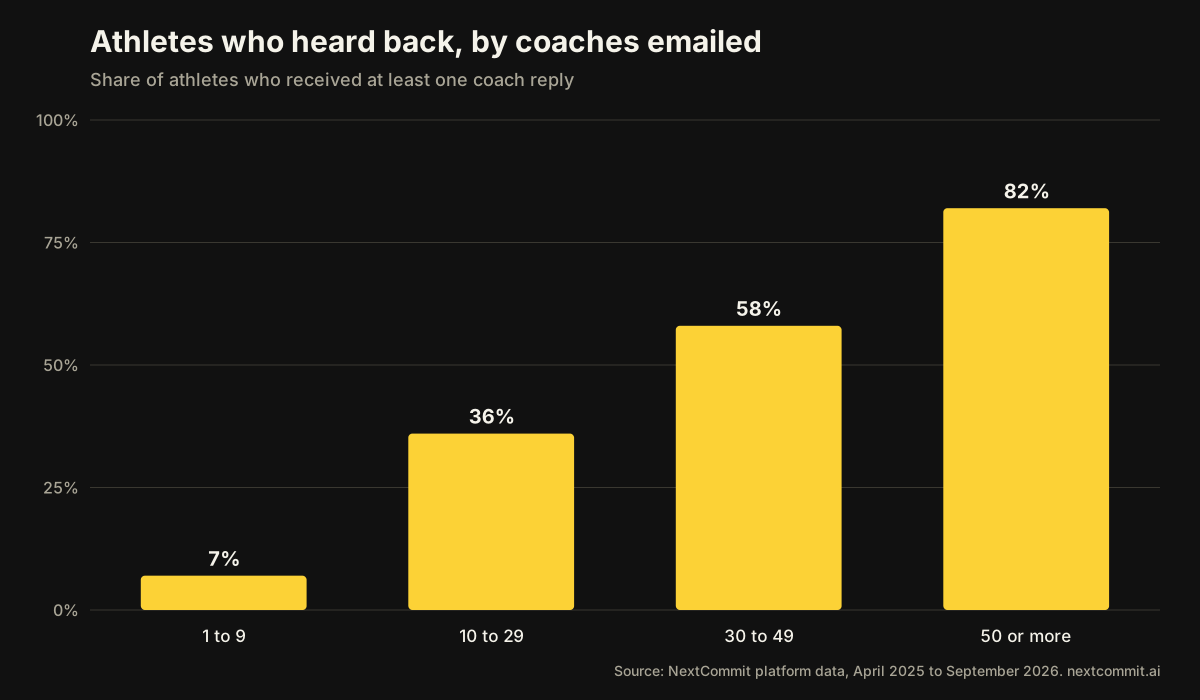
- List size is the biggest lever. Athletes who emailed 50 or more coaches heard back 82% of the time. Fewer than 10 coaches: 7%.
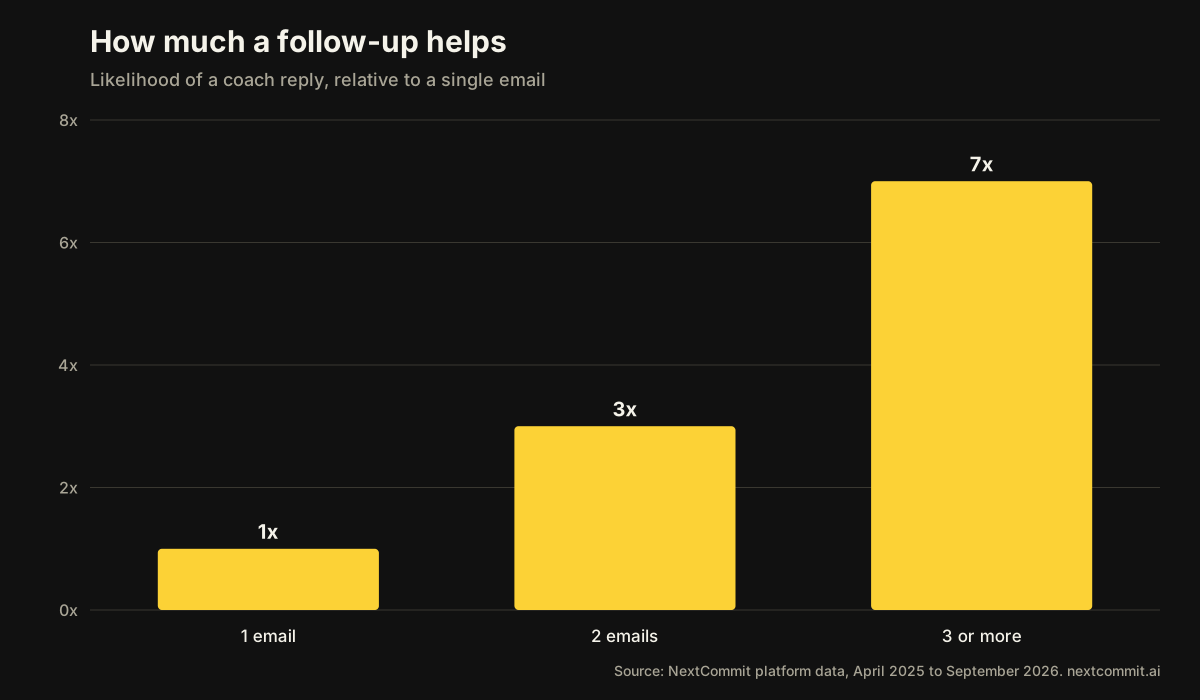
- Follow-ups work. A conversation with one follow-up was about 3 times as likely to get a reply as a single email; two or more follow-ups, about 7 times.
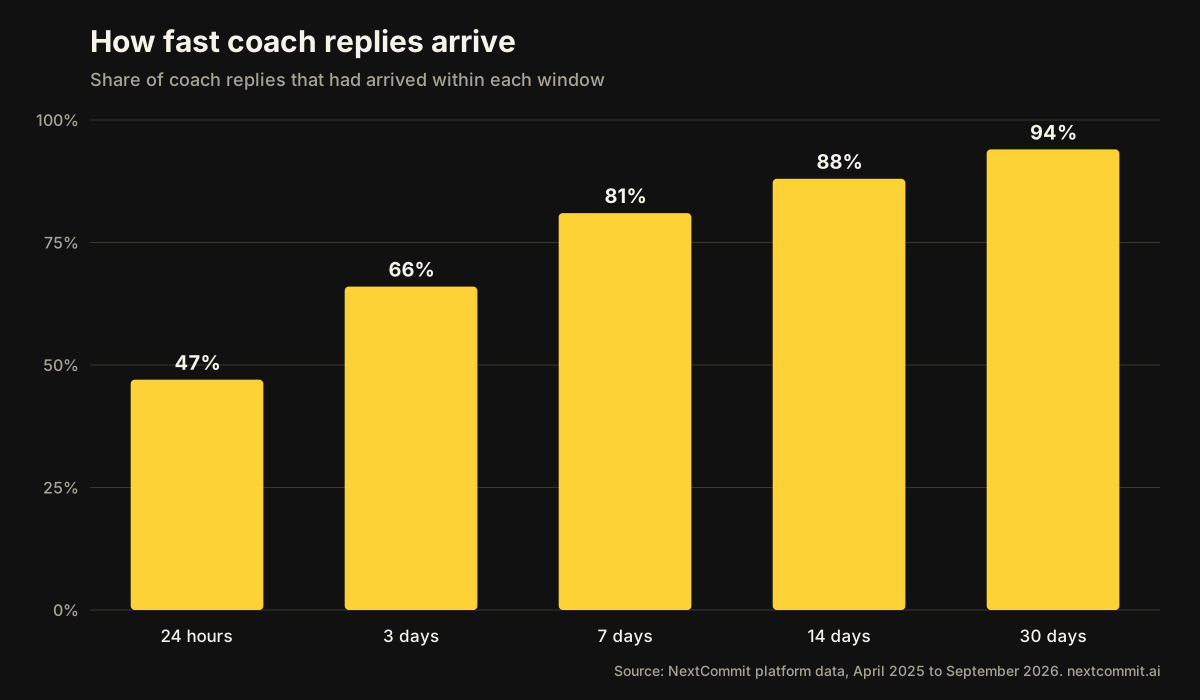
- Replies come fast. 47% of coach replies arrived within 24 hours and 81% within a week. Silence after a week means it is time to follow up.
- Timing is sport-specific. Baseball coaches reply most in summer and on weekends, football coaches in January and on Thursdays around noon, softball coaches on weekend evenings. The full table is below.
How many coaches should you email?
This is the number that matters most, and it is entirely in the athlete's control. We grouped athletes by how many different coaches they wrote to and checked what share of them heard back from at least one.
The pattern held inside every sport with enough athletes to measure. Baseball athletes who emailed 50 or more coaches heard back 91% of the time; men's basketball athletes, 76%; football athletes, 53%, up from 4% for those who emailed fewer than 10. Soccer athletes who wrote to 50 or more programs heard back in every case we could measure.
Part of this is simple math: more emails, more chances. Part of it is that athletes who write to 50 programs are also the ones who spread the list across D1, D2, D3, NAIA, and junior college instead of emailing only the biggest names. The list does not have to be finished in a week. Athletes who reach 50 over a season do as well as those who send them all at once.
| Coaches emailed | Athletes who heard back from at least one coach |
|---|---|
| 1 to 9 | 7% |
| 10 to 29 | 36% |
| 30 to 49 | 58% |
| 50 or more | 82% |
How much does a follow-up help?
A lot. We compared conversations where the athlete sent one email with conversations where the athlete sent two, and three or more.
The lift shows up in every sport. Football conversations with a follow-up were many times as likely to get a reply as single-email conversations, and the same was true in baseball, softball, and basketball. Some of that is persistence paying off and some is that athletes with real updates to share are the ones who follow up, which is exactly the habit to copy.
The follow-up that works is not "just checking in." It is new film, a tournament schedule with your jersey number, a new verified measurable, a grade update, or a camp you registered for. Space them 7 to 10 days after the first email and then every 4 to 6 weeks.
| Emails the athlete sent in the conversation | Likelihood the coach replied, relative to a single email |
|---|---|
| 1 email | 1x (baseline) |
| 2 emails (one follow-up) | about 3x |
| 3 or more emails | about 7x |
How fast do coaches reply?
When a coach is going to answer, the answer usually comes quickly. We measured the time from an athlete's first email to the coach's first reply.
Two practical rules fall out of this. First, check your inbox the day after you send; nearly half of the replies you will ever get from that batch arrive in the first 24 hours, and a fast, specific answer from you keeps the conversation alive. Second, a week of silence is a signal, not a rejection. Four out of five replies have already arrived by day seven, so that is the moment to send the follow-up with something new.
Basketball and soccer coaches were the fastest responders in our data, with about half of replies inside 24 hours. Football and softball coaches took a little longer on average, which is one more reason the follow-up matters in those sports.
| Time after the email was sent | Share of coach replies that had arrived |
|---|---|
| Within 24 hours | 47% |
| Within 3 days | 66% |
| Within 7 days | 81% |
| Within 14 days | 88% |
| Within 30 days | 94% |
When should you send, by sport?
Every sport has its own calendar, and the reply patterns follow it. For each sport we compared months, days of the week, and send hours against that sport's own average, so these are the best windows for your sport, not a ranking of sports against each other. Hours are US Central time.
The months line up with when coaches are building next year's roster rather than coaching this year's. Baseball and softball coaches reply most in summer, when the season is over and the showcase circuit is running. Football coaches reply most in January, after signing day when they know exactly which spots are still open, and again in November and December. Basketball coaches are most responsive in early summer.
Send-time patterns are less about the calendar and more about when coaches sit down with email. Evenings from 5 to 9 pm Central drew the most replies overall, and 7 to 9 am drew the fewest, which is when most coaches are in practice, class, or the weight room. If you are outside the Central time zone, shift the windows to match the school you are writing to.
Women's soccer athletes on the platform are a smaller group, so their month and hour patterns are not stable enough to publish yet. Their open rate was the highest of any sport we track.
| Sport | Best months | Best days | Best send time |
|---|---|---|---|
| Baseball | June, July, and August (summer showcase season); May next | Sunday and Friday; weekends beat weekdays by about a quarter | Around 5 pm, and early morning before 7 am |
| Football | January (by far), then November and December | Thursday and Friday; weekdays beat weekends | Late morning to noon, 11 am to 12 pm |
| Softball | May, August, and December | Friday and Sunday; weekends beat weekdays | Evening, 7 to 9 pm |
| Men's basketball | July, then June and August | Thursday and Friday | Early afternoon, around 1 pm, and again around 4 pm and 8 pm |
| Women's basketball | June and July | Monday and Tuesday | Midday and mid-afternoon, noon to 3 pm, and around 7 pm |
| Men's soccer | May, June, and July | Wednesday and Thursday | Evening, around 8 pm, and early afternoon |
Do coaches actually read these emails?
They do. About 46% of athlete emails were opened, measured with the same open tracking the platform shows athletes in their dashboard. Every sport we track cleared 4 in 10, and the women's sports cleared 5 in 10. For comparison, typical business email campaigns see open rates in the 20% to 30% range.
Open rate is why the rest of this page matters. Coaches are reading. The gap between a read and a reply is closed by list size, timing, follow-ups, and an email that makes the fit obvious in two lines: graduation year, position, one verified number, GPA, and a film link.
How to use these numbers in your own outreach
The data points to a simple sequence.
- 1Build a list of 50 programs across levels. Athletes who reached 50 heard back 82% of the time. Include D1 targets and the D2, D3, NAIA, and junior college programs that fit your numbers; the Recruit Score shows which levels those are.
- 2Send in your sport's window and at your sport's hour. Use the table above: summer weekends for baseball and softball, January weekdays around noon for football, early summer for basketball and soccer.
- 3Lead with the numbers a coach can act on: graduation year, position, one verified measurable, GPA, and a film link. Coaches open nearly half of these emails; the ones that get replies make the fit obvious in the first two lines.
- 4Reply fast when a coach writes back. Nearly half of replies land within 24 hours; answer the same day with the specific thing they asked for.
- 5Follow up after 7 to 10 days with something new, then every 4 to 6 weeks. A follow-up makes a reply about 3 times as likely; two follow-ups, about 7 times.
- 6For D1 and junior college programs, do not stop at email. Submit the program's recruiting questionnaire so you are in the staff's system, then call the office. NextCommit's questionnaire tool reuses your profile answers to fill school forms faster, and you review and submit each one yourself.
Run this sequence with tracking built in
NextCommit drafts each email for the specific program, sends from your inbox, shows which coaches opened and replied, reminds you when to follow up, and speeds up the school questionnaires.
Methodology and limitations
- Data: athlete-to-coach emails and conversations recorded on the NextCommit platform from April 19, 2025 through September 6, 2026, aggregated and anonymized with a read-only script. No message content or personal data was reviewed, and email volumes are not published.
- Comparisons: months, days, and hours are compared against each sport's own average, and follow-up effects against that sport's single-email baseline, so no sport is measured against another. Only cuts with at least 50 emails are reported.
- Time zones: send hours are converted to US Central time. Athletes and coaches span several time zones, so treat the hour windows as approximate.
- Correlation, not causation: athletes who email 50 coaches and follow up are also the most organized athletes, and some of their success comes from that. The habits are still the ones to copy.
- Open rate: measured with tracking pixels, so it includes Apple Mail Privacy Protection prefetches and excludes image-blocked opens. Treat it as a measured figure, not a true read rate.
- Refresh cadence: the study is re-run quarterly with the same script, and the page's updated date changes when the numbers do.
Written by
Adam Paganelli
Co-founder, NextCommit
Adam Paganelli is a co-founder of NextCommit. He played college baseball at Green River College, Sacramento City College, and Northwest Nazarene University after graduating from Tahoma High School in 2018, and he builds the AI outreach, Recruit Score, and coach database tools athletes use on NextCommit.
- Co-founder, NextCommit
- College baseball: Green River College, Sacramento City College, Northwest Nazarene University
- Tahoma High School, Class of 2018
More guides by Adam and the editorial policy.
Sources
Where these numbers come from
- NCAA recruiting calendars Contact and dead periods that shape the best months for each sport.
- NextCommit editorial policy How platform data is used in published research.
FAQ
Questions athletes and parents ask
Do college coaches read recruiting emails from athletes?
Yes. Across NextCommit platform data, coaches opened about 46% of athlete emails, and every sport we track cleared 4 in 10. That is a higher measured open rate than most professional email campaigns see.
How many college coaches should I email?
More than most athletes think. Athletes who emailed 50 or more coaches heard back from at least one 82% of the time. Athletes who emailed 30 to 49 heard back 58% of the time, 10 to 29 heard back 36% of the time, and fewer than 10 heard back only 7% of the time. Build a list of 50 programs across levels.
How long do college coaches take to respond to an email?
When a coach replies, it usually happens fast: 47% of replies arrived within 24 hours, 66% within three days, and 81% within a week. Only about 6% took longer than 30 days. If a week passes with no reply, send a follow-up rather than waiting.
Should I follow up with a college coach who did not reply?
Yes. Conversations where the athlete sent a follow-up were about 3 times as likely to end with a coach reply as single-email conversations, and conversations with two or more follow-ups were about 7 times as likely. Follow up after 7 to 10 days with something new: film, a schedule, a new measurable, or a grade update.
What is the best time of day to email a college coach?
Late afternoon and evening, roughly 5 to 9 pm Central, drew the most replies overall, and early morning (7 to 9 am) drew the fewest. The best window shifts by sport: baseball coaches replied most to emails sent around 5 pm, football coaches around noon, softball coaches between 7 and 9 pm, and basketball coaches in the early afternoon.