
The short answer
The best college coach emails are short, specific, and easy to evaluate. A coach should know your grad year, position, academic profile, key performance numbers, and where to watch film in less than thirty seconds.
The structure is the same across sports, but the proof changes. Baseball and softball athletes lead with velocity, pop time, exit velocity, travel-ball context, and recent production. Football athletes lead with height, weight, speed, position measurables, and film. Soccer athletes lead with club level, position, dominant foot, GPA, film, and upcoming showcase or ID camp schedule. Basketball athletes lead with position group, height, production, film, schedule, and role fit.
Copy-paste college coach email template
Use this subject line formula and 6-line email for your first message to any college coach. Fill in the brackets and rewrite the reason line for every program.
| Line | What to write |
|---|---|
| Subject | [Grad Year] [Position] | [Top Stat] | [GPA] GPA | [City, State] |
| Example subject | 2027 RHP | 87 mph | 3.8 GPA | Denver, CO |
| 1 | Coach [Last Name], |
| 2 | I am [Full Name], a [Grad Year] [Position] at [High School] and [Club or Travel Team] in [City, State]. |
| 3 | My numbers: [Top Stat], [Second Stat], and a [GPA] GPA. Film: [link] |
| 4 | I am reaching out because [one specific reason the program fits]. |
| 5 | I will play at [Event] on [Dates]. Would you watch, or tell me if I fit your [Grad Year] class? |
| 6 | Thank you, [Full Name] | [Phone] | [Email] |
Generate the first draft now
Use the free generator to turn your sport, position, grad year, top stat, GPA, film link, and target school into a coach-ready email.
What do college coaches want in a first email?
Coaches do not need your full life story in the first touch. They need enough signal to decide whether you belong on their board.
- Your name, graduation year, primary position, and hometown or school.
- A few proof points that match your sport and position.
- One clear link to your film, profile, or metrics page.
- A specific reason you are contacting that program instead of sending a blast to everyone.
- A simple next step, such as asking whether they would like updated film or a transcript.
How should you structure an email to a college coach?
Start with a subject line that helps a coach route you quickly. Then open with a direct sentence that identifies who you are and why you are reaching out. Follow that with the two or three strongest reasons a coach should care, then link to film and close with a low-friction ask.
If you try to sound impressive instead of clear, the email gets worse. The goal is not to sound like a recruiter. The goal is to make it obvious that you are a real prospect who understands fit.
| Section | What to include |
|---|---|
| Subject line | Name, grad year, position, and one core signal such as velocity or team name |
| Opening | Who you are and why you are contacting that school |
| Proof | Stats, measurables, academics, team context, or recent updates |
| Link | Film, profile, schedule, or metrics page |
| Close | A short thank-you and one clear next step |
What subject line should you use when emailing a college coach?
The subject line does not need to be clever. It needs to be sortable. A coach should be able to glance at it and know your class, your role, and one reason to click.
- Baseball: 2027 RHP | 87 mph | 3.8 GPA | Denver, CO
- Baseball: 2026 Catcher | 1.92 pop time | club schedule attached
- Baseball: 2027 SS | 6.84 60-yard dash | summer schedule inside
- Softball: 2026 Softball Pitcher | 63 mph | 3.9 GPA | interest in [School]
- Softball: 2027 Corner IF | .412 avg | travel schedule and film
- Football: 2027 WR | 6'1 185 | 4.52 forty | film inside
- Football: 2026 OL | 6'4 285 | 315 bench | 3.5 GPA | [School] interest
- Football: 2027 QB | 6'2 195 | 2,400 yds 24 TD | film + schedule
- Women's Soccer: 2027 Winger | ECNL | 3.8 GPA | showcase schedule
- Men's Soccer: 2026 Center Back | MLS NEXT | 6'1 | film + ID camp
- Soccer: 2028 Goalkeeper | GA | clean sheets + full-game film
- Basketball: 2027 PG | 6'1 | 3.8 GPA | film + July schedule
- Basketball: 2026 Wing | 6'4 | 38% from 3 | full-game film
- Basketball: 2027 Post | 6'8 | 10 RPG | spring schedule
Email templates you can adapt
These examples are intentionally plain. Coaches reward clarity and fit more than polished sales language. Position versions with a filled example, benchmarks, and a follow-up for baseball pitchers, catchers, softball pitchers, quarterbacks, and wide receivers are listed under Related pages.
Baseball template
Coach [Last Name], my name is [Name] and I am a 2027 RHP at [High School] in [City, State]. I am reaching out because I have been researching programs that value strike-throwers with projection and strong academics, and [School] stands out. I am currently 6 foot 2, 185 pounds, sit 84 to 87 mph, carry a 3.8 GPA, and play for [Travel Team]. Here is my video and profile: [link]. I would appreciate the chance to stay on your radar and send updates from my spring season. Thank you for your time.
Softball template
Coach [Last Name], I am [Name], a 2026 catcher from [High School and Travel Team]. I wanted to introduce myself because I am interested in programs where I can contribute behind the plate and continue developing offensively. I have a 3.9 GPA, recent game video here [link], and this season I am hitting [stat line] with a pop time of [metric] and a caught-stealing rate of [metric]. I would love to know whether you are still evaluating 2026 catchers. Thank you for your time.
Football email templates
Football recruiting emails follow the same structure but lead with position-specific measurables. Include your height, weight, speed, and film link upfront.
Football skill position template (WR, RB, DB, LB):
Coach [Last Name], my name is [Name] and I am a 2027 [Position] at [High School] in [City, State]. I am [height], [weight] with a [40 time] forty and a [vertical] vertical. I play for [team] and earned [honors or stats]. I have been researching [School] because [specific reason about the program, conference, coaching staff, or academic fit]. Here is my highlight film: [link]. I would appreciate any feedback on my film and the chance to stay on your recruiting board. Thank you for your time.
Football lineman template (OL, DL):
Coach [Last Name], I am [Name], a 2026 [Position] at [High School] ([City, State]). I am currently [height], [weight] with a [bench press] bench and [squat] squat. I play [position details] and started [number] games last season. I am interested in [School] because [specific reason]. My film is here: [link]. I would appreciate the chance to be evaluated and learn more about your program. Thank you.
Football quarterback template:
Coach [Last Name], I am [Name], a 2027 QB at [High School] in [City, State]. I am [height], [weight], throw [velocity or distance], and completed [stat line] last season. I run a [system type] offense and have been studying your program because [specific reason about the system, coaching philosophy, or academic fit]. My film is here: [link]. I would appreciate any feedback and the chance to attend one of your camps this summer. Thank you for your time.
Soccer email templates
Soccer recruiting emails should make role, level, schedule, and film easy to evaluate. A coach should know where you play, what position you project to, and when they can watch you live.
Soccer field player template:
Coach [Last Name], my name is [Name] and I am a 2027 [Position] for [Club/Academy] and [High School] in [City, State]. I am [height], [dominant foot], carry a [GPA] GPA, and have been researching [School] because [specific academic, roster, location, or playing-style fit]. My highlight film is here: [link], and I will be playing at [Event] on [dates/field/times]. I would appreciate any feedback on whether my profile fits your 2027 recruiting board. Thank you for your time.
Soccer goalkeeper template
Coach [Last Name], I am [Name], a 2026 goalkeeper with [Club/Academy] in [City, State]. I am [height], [dominant foot], have a [GPA] GPA, and my recent film includes shot-stopping, distribution, crosses, and game management clips: [link]. I am interested in [School] because [specific fit]. I will be at [Event] on [dates/field/times] and would appreciate the chance to stay on your radar.
Follow-up email templates that add value
Follow-up emails should never just ask "did you see my first email?" Each follow-up needs to give the coach a new reason to pay attention.
Follow-up after no response (7 to 10 days):
Coach [Last Name], I wanted to follow up on my email from last week. Since then, [share one new data point: updated stat line, new tournament result, academic update, or new film clip]. I am still very interested in [School] and would appreciate any guidance on next steps. Updated film: [link]. Thank you.
Follow-up after a camp or showcase:
Coach [Last Name], I wanted to thank you for the opportunity to compete at [Camp/Event Name] this past weekend. I wore jersey [number] and was in the [position group/drill group]. I felt good about [specific drill or moment], and I wanted to share my updated film from the event: [link]. I would appreciate any feedback on my performance. Thank you for your time.
Follow-up after an unofficial visit:
Coach [Last Name], thank you for taking the time to meet with me during my visit to [School] on [date]. I was impressed by [specific detail about the visit: facilities, academic support, team culture, coaching philosophy]. [School] is one of my top choices, and I wanted to share my updated film and academic transcript: [link]. Please let me know if there is anything else I can provide. Thank you.
Season update email (send monthly during the season):
Coach [Last Name], I wanted to share a quick update from my [spring/fall] season. Through [number] games, I am [key stat line]. [One notable recent performance or milestone]. My updated schedule is attached if you are in the area. Film: [link]. Thank you for staying in touch.
What stats should you include when emailing a coach?
The wrong stats in your email signal that you do not understand what coaches evaluate. Here is exactly what to lead with for each sport.
Notice that GPA appears in every row. Academics are not optional context. They are core recruiting data. A coach who sees strong measurables and a low GPA immediately questions eligibility and roster risk.
| Sport | Position | Lead With These Stats |
|---|---|---|
| Baseball | Pitcher (RHP/LHP) | Fastball velocity, secondary pitch types, K/9 or K rate, ERA, GPA |
| Baseball | Catcher | Pop time, exit velocity, batting average, caught-stealing rate, GPA |
| Baseball | Infielder | 60-yard dash, exit velocity, fielding percentage, batting average, GPA |
| Baseball | Outfielder | 60-yard dash, exit velocity, arm strength, batting average, stolen bases, GPA |
| Softball | Pitcher | Pitch speed, strikeout rate, ERA, pitch repertoire, batting stats if applicable, GPA |
| Softball | Catcher | Pop time, batting average, throwing accuracy, on-base percentage, GPA |
| Softball | Position Player | Home-to-first time, batting average, slugging, defensive position, GPA |
| Football | QB | Height, weight, arm velocity, completion %, TD/INT ratio, 40 time, GPA |
| Football | WR/RB/DB | Height, weight, 40 time, vertical jump, shuttle, key game stats, GPA |
| Football | OL/DL | Height, weight, bench press, squat, 40 time, games started, GPA |
| Football | LB | Height, weight, 40 time, bench press, tackles per game, shuttle, GPA |
| Soccer | Field player | Position, dominant foot, club or academy team, GPA, film link, upcoming schedule |
| Soccer | Goalkeeper | Height, dominant foot, save percentage, clean sheets, goals against average, distribution film, GPA |
| Basketball | Guard | Height, dominant hand, points, assists, turnovers, shooting %, steals, GPA, film link, schedule |
| Basketball | Wing/Forward | Height, wingspan if known, rebounds, shooting %, defensive role, athletic signals, GPA, film |
| Basketball | Post | Height, rebounding, blocks, efficiency, mobility, screening, GPA, full-game film |
| Women's Volleyball | Outside, opposite, or middle | Height, standing reach, approach and block touch with where they were measured, kills and hitting percentage or blocks, club team and level, GPA, film |
| Women's Volleyball | Setter | Height, assists per set, tempo and location on film, blocking, club team and level, GPA |
| Women's Volleyball | Libero or DS | Serve receive and passing numbers if tracked, digs per set, serving, club team and level, GPA, full rotation film |
| Women's Flag Football | Quarterback | Completion %, passing touchdowns, TD/INT ratio, 40 time, flag team or league, other sports, GPA, film |
| Women's Flag Football | Receiver, center, or running back | 40 time, 5-10-5 shuttle, catches, yards, touchdowns, flag team or league, other sports, GPA, film |
| Women's Flag Football | Rusher or defensive back | 40 time, 5-10-5 shuttle, flag pulls, interceptions, pass breakups, flag team or league, GPA, film |
| Track and Field | Sprints and hurdles | Events and PRs with meet, date, FAT or hand timing, and wind; results profile link; meet schedule; GPA |
| Track and Field | Distance and cross country | 800m, 1600m or mile, 3200m, and cross country course times with course names; results profile link; GPA |
| Track and Field | Jumps, throws, or multis | Certified marks with meet and date, wind for horizontal jumps, implement weight for throws, technique video, GPA |
Full first-contact template (copy and paste)
This is the same template structure that NextCommit athletes use to send their first email to college coaches. Copy it, fill in your details, and personalize the school-specific line for each program.
Subject: [Your Name] | [Grad Year] | [Position] | Interest in [School Name]
Coach [Last Name],
I hope this message finds you well. My name is [Your Name], and I am a [Grade Level] [Position] at [Your School] in [City, State]. I am reaching out to express my strong interest in [School Name]'s [baseball/softball/football/soccer/basketball] program.
Athletically, I have recorded [Key Metrics - e.g. 87 mph fastball, 1.92 pop time, .412 batting average] and [Key Stats - e.g. led my team in strikeouts, earned all-conference honors].
[Link to your highlight film or recruiting profile]
Academically, I currently maintain a [GPA] GPA. I am committed to excelling both academically and athletically, and I am eager to contribute to a program with [School Name]'s reputation for [specific thing you like about the program].
I would appreciate the opportunity to discuss next steps in the recruiting process and the potential to play at [School Name].
Best,
[Your Name]
[Your School] | [City, State]
[Phone Number]
You can also adapt this template for specific situations. Use a tournament invite version when you have upcoming events, or a season schedule version when you want coaches to come watch you play.
Generate your first coach email
If you want a faster starting point, use the free NextCommit coach email generator. It turns your sport, position, graduation year, strongest stat, film link, target school, and program-fit reason into a coach-ready subject line and email draft.
The generator is best for getting the first version written quickly. Before sending, still review the school-specific line and make sure the film link, schedule, and proof points are current.
Create a coach-ready email draft
Use your sport, position, grad year, strongest stat, film link, and target school to generate a subject line and first draft.
The problem with sending this template yourself
This template works for one email. But you need 30 to 50 emails to build a real recruiting list, and a coach can tell when the same email went to every school. Rewrite the reason line for every program, or let NextCommit draft a personalized email for each coach.
The athletes who get responses are the ones who personalize every single email: referencing the specific program, the position coach by name, something real about why that school fits. Doing that manually for 40 programs takes 15 to 20 hours of research and writing. Most families spend an entire weekend and burn out after 10 emails.
That is the problem NextCommit solves. You fill out your profile once with your measurables, GPA, film links, and goals. Then NextCommit uses AI to write a genuinely personalized email for every coach on your list, each one referencing that specific program, that coach, and why you are a fit for their roster. You review each email before it sends. No mass blasts. No copy-paste. Every message reads like you spent 20 minutes writing it, because the AI actually did the research.
You can send your first emails free. No credit card required.
What mistakes hurt coach email response rates?
Most bad coach emails fail because they create work. A coach has to hunt for your position, guess your level, or click through too many attachments. Good emails reduce work.
- Sending the exact same email to every school with no sign of fit.
- Writing long paragraphs before showing your position, class, or numbers.
- Attaching too many files instead of using one clean link.
- Talking about effort, passion, or leadership without giving evidence a coach can evaluate.
- Following up with “just checking in” instead of sharing something new.
What should you send coaches during your active recruiting window?
In-season outreach works when the email contains fresh proof. That can be updated velocity, a new tournament schedule, recent game clips, a strong stat line, a showcase schedule, a full-game film link, or an academic update.
For soccer, event context matters. If a coach can watch you at an ECNL, MLS NEXT, GA, club showcase, high school playoff match, or ID camp, include exact field numbers, kickoff times, jersey number, and opponent.
For basketball, schedule context matters. If a coach can watch you at an AAU tournament, live period, high school showcase, camp, or playoff game, include the event name, court number, game time, jersey number, opponent, and the role you expect to play.
How often should you follow up with a college coach?
Every follow-up should earn its way into the inbox. New film, new metrics, new tournament dates, and stronger academics all count. Empty nudges do not.
- Day 0: send the introduction email.
- Day 7 to 10: send one short follow-up with a useful update.
- After that: send an update every 4 to 6 weeks, and only when you have new film, stats, camp results, or grades.
Build the rest of the process around the email
The email is only one piece of recruiting. It works best when it sits on top of a realistic school list, a clear view of your current level, and film that matches the claims in the message.
That is why the strongest sequence is simple: get a realistic recruiting read, build the coach list, send personalized outreach, then follow up with updates from the season. If you skip the fit step, you usually end up sending good emails to the wrong programs.
Written by
Adam Paganelli
Co-founder, NextCommit
Adam Paganelli is a co-founder of NextCommit. He played college baseball at Green River College, Sacramento City College, and Northwest Nazarene University after graduating from Tahoma High School in 2018, and he builds the AI outreach, Recruit Score, and coach database tools athletes use on NextCommit.
- Co-founder, NextCommit
- College baseball: Green River College, Sacramento City College, Northwest Nazarene University
- Tahoma High School, Class of 2018
More guides by Adam and the editorial policy.
Sources
Where these numbers come from
- NextCommit study: what gets college coaches to reply (2026 data) Open rates, list size, follow-ups, reply timing, and best send windows by sport.
- NCAA recruiting calendars Official contact, evaluation, quiet, and dead periods by sport and division.
- NCAA Eligibility Center Registration, core-course, and amateurism requirements for Division I and II.
FAQ
Coach email questions athletes ask most
What should I put in the first email to a college coach?
Keep the first email short. Include who you are, your grad year, position, school or travel team, core measurables or stats, your academic snapshot, a film or profile link, and one reason the school is a fit.
How long should an email to a college coach be?
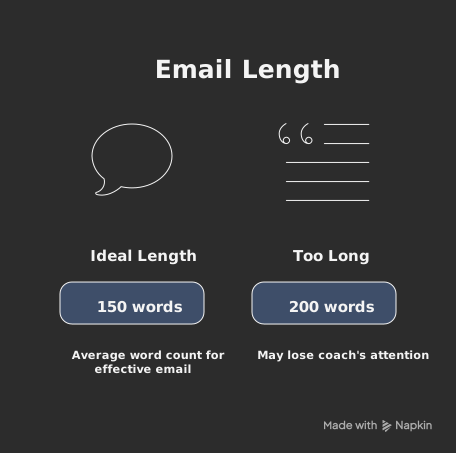
Aim for roughly 120 to 150 words. Coaches scan fast. If the message is longer than that, they are less likely to get to the film and profile links you actually need them to click.
Should baseball and softball athletes email coaches differently?
The structure is the same, but the proof points change. Baseball players should lead with position-specific tools like velocity, exit velocity, pop time, and 60-yard dash times. Softball players should lead with role, pitch speed, offensive production, and travel-ball context.
When should I follow up with a college coach?
If a coach has not replied, follow up in 7 to 10 days with a short update, a new stat line, or a fresh video clip. The follow-up should add value rather than just asking whether they saw the first email.
How do football athletes email college coaches differently?
Football emails should lead with height, weight, speed, and position-specific measurables. QBs include arm velocity and completion stats. Linemen include bench press, squat, and games started. Skill position players include 40 time, vertical, and key game stats. Always include a film link and your GPA.
How do soccer athletes email college coaches differently?
Soccer emails should lead with position, dominant foot, club or academy team, graduation year, GPA, film, and upcoming showcase or ID camp schedule. Coaches also need role clarity: outside back, center back, six, winger, striker, goalkeeper, or secondary positions.
How do basketball athletes email college coaches differently?
Basketball emails should lead with position group, height, graduation year, GPA, current team, recent production, film, schedule, and role fit. Guards, wings, forwards, and posts should each frame the message around the actions coaches evaluate for that role.
How many college coaches should I email?
Plan to reach out to 30 to 50 programs that match your athletic and academic profile. Sending fewer than 15 emails risks missing opportunities. Sending 200 generic emails wastes time and annoys coaches. Focus on programs where your measurables, grades, and goals genuinely fit.