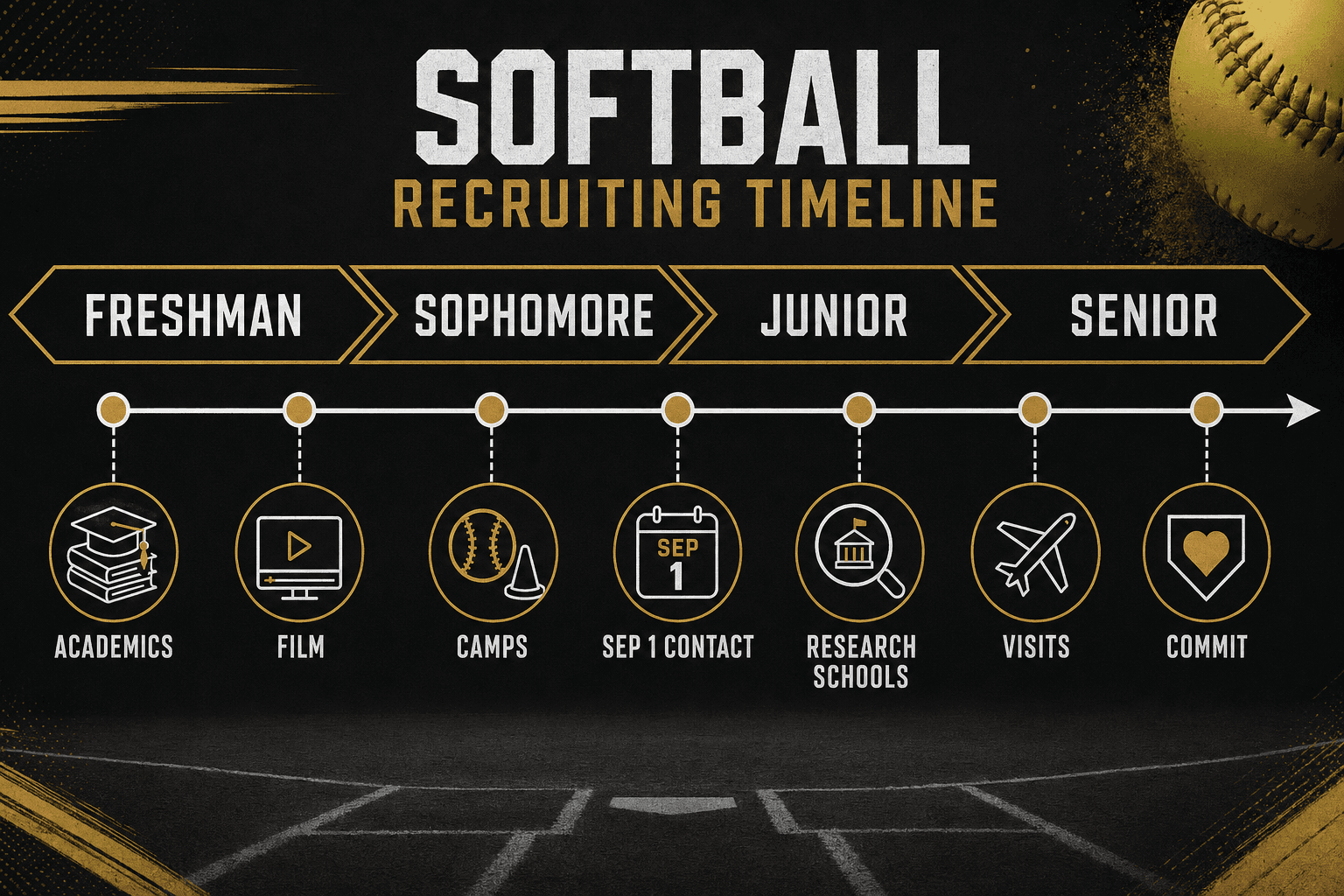
The short answer: the softball recruiting timeline
Start softball recruiting freshman year by building your profile, filming games, tracking measurables, and protecting your GPA. Sophomore year is for showcases, camps, a realistic school list, and early outreach. Junior year is the peak D1 communication window because September 1 of junior year unlocks direct D1 coach communication. Senior year is for visits, signing, and late outreach to D2, D3, NAIA, and JUCO programs.
The athletes who win the softball recruiting process do not wait for September 1 to begin. They use freshman and sophomore year to build the evidence coaches need: pitching velocity, exit velocity, home-to-first time, catcher pop time, skills video, academic profile, and a travel schedule. By the time coaches can reply, the strongest recruits are already easy to evaluate.
Every sport, every period, one page
Contact, evaluation, quiet, and dead periods plus every 2026-2027 signing window, for softball and every other NCAA sport.
Which softball recruiting dates matter most in 2026-2027?
Always verify exact dead periods and sport-specific calendars with the NCAA and the school compliance office. These are the planning dates families should build around.
| Timing | Recruiting event | What athletes should do |
|---|---|---|
| Freshman year | Profile and film foundation | Track GPA, measurables, game film, travel team schedule, and primary/secondary positions. |
| Sophomore fall | Target list building | Research 30 to 50 programs by division fit, academics, region, roster needs, and coaching staff. |
| June 15 after sophomore year | D2 in-person contact and official visits can begin | D2 coaches can already call, text, email, and send materials at any time, so have your profile link, film, GPA, and event schedule ready before this date. |
| Summer before junior year | Peak showcase and camp window | Attend camps and showcases where realistic-fit coaches will evaluate your class and position. |
| September 1 of junior year | D1 direct communication opens | Send updated film and metrics, answer coach calls, schedule visits, and qualify real interest. |
| Junior fall through spring | Offer and visit window | Compare programs, ask scholarship and roster-cap questions, and keep D2/D3/NAIA options active. |
| Senior fall | Signing and late-recruiting push | Take visits, send senior film, and expand outreach if D1 rosters are already full. |
| Senior spring and summer | Late D2, D3, NAIA, and JUCO recruiting | Use updated film and academics to target programs still filling spots. |
Freshman year: build the proof before anyone asks for it
Freshman year should feel boring in the best way. You are not trying to force offers. You are building the evidence that makes later outreach credible.
- Protect your GPA immediately. Academic fit can create opportunities at D3, high-academic D1, D2, and NAIA schools where athletics alone will not carry the application.
- Start a measurable log: pitching velocity, exit velocity, home-to-first, 60-yard dash, pop time for catchers, overhand throwing velocity, and strength numbers.
- Film games and position work from usable angles. Coaches need to see game-speed reps, not only edited celebration clips.
- Play competitive travel ball when possible, but do not treat a travel roster as a recruiting strategy by itself.
- Research the difference between D1, D2, D3, NAIA, and JUCO softball so your family does not spend two years chasing only Power 4 programs.
- Use the Softball Recruit Score to get a first read on division fit, then retest every 90 days so you can show improvement.
Sophomore year: get evaluated and build the list
Sophomore year is when the recruiting calendar turns from preparation into action. D1 coaches may still be restricted in direct communication, but they are watching, organizing boards, and deciding who they want to know on September 1.
- Build a 30 to 50 school target list with reach, target, and safety programs across more than one division.
- Create a first skills video with your strongest position reps, verified measurables, GPA, graduation year, travel team, and contact information.
- Attend college camps at schools where your measurable profile fits. A smaller camp at the right school is better than a big showcase with no realistic-fit coaches watching.
- Begin introductory emails to coaches with your profile, film, event schedule, and a specific reason the school fits. D1 coaches may be limited in replies, but your email can still put you on a board.
- Update your metrics after each training block and every major event. Coaches care about trajectory, not just one number.
- Register with the NCAA Eligibility Center if D1 or D2 is a realistic target.
Junior year: September 1 and the peak evaluation window
Junior year is the highest-leverage year in softball recruiting. September 1 opens direct D1 communication, summer and fall events create evaluation opportunities, and serious offers often come from the relationships built before this year started.
- Send updated outreach in the week before September 1 with your best film, current metrics, GPA, travel schedule, and clear school-specific fit.
- Answer coach calls quickly and prepare questions about roster needs, scholarship structure, admissions, position fit, and timeline.
- Take unofficial and official visits only when there is real mutual interest. A campus visit is valuable when it helps you evaluate a possible offer, not when it becomes an expensive tour.
- Ask how the 25-player D1 roster cap affects your class and position. Every D1 softball spot now matters, so families need direct clarity.
- Keep D2, D3, NAIA, and JUCO options active even if D1 interest appears. D1 attention is not the same thing as an offer.
- Track every email open, film click, call, text, camp conversation, and visit. Follow up with engaged coaches first.
Senior year: close, sign, or expand fast
Senior year is not too late, but the strategy changes. Power 4 and many D1 rosters may be close to full, while D2, D3, NAIA, and JUCO programs often continue evaluating through fall, winter, spring, and summer.
- Send senior-year film immediately. Coaches want the freshest proof you have, especially if you improved late.
- Rebuild your school list around realistic roster openings, not old dream schools that have stopped recruiting your position.
- Prioritize programs that open emails, click film, invite you to visit, ask for transcripts, or request your schedule.
- Ask direct questions about admissions, scholarship timeline, roster size, and whether your position is still open.
- Attend uncommitted showcases only when the attending coach list matches your division fit.
- Do not ignore D3 and high-academic schools. Many of the best senior-year opportunities come from academic fit plus clear coach need.
What are the softball recruiting standards by division?
The timeline only works if the target list is realistic. Coaches use measurable data as the first filter before they spend time with a full video or transcript.
These numbers are not guarantees. A pitcher with elite spin, command, and movement can outperform a harder thrower. A hitter with average exit velocity but elite bat-to-ball skills and speed can still fit. But if your numbers are far below the range for a level, your outreach list should adjust before you waste months emailing programs that will not recruit you.
This is why NextCommit starts with division fit. A realistic target list creates better replies, better camp choices, and a cleaner timeline.
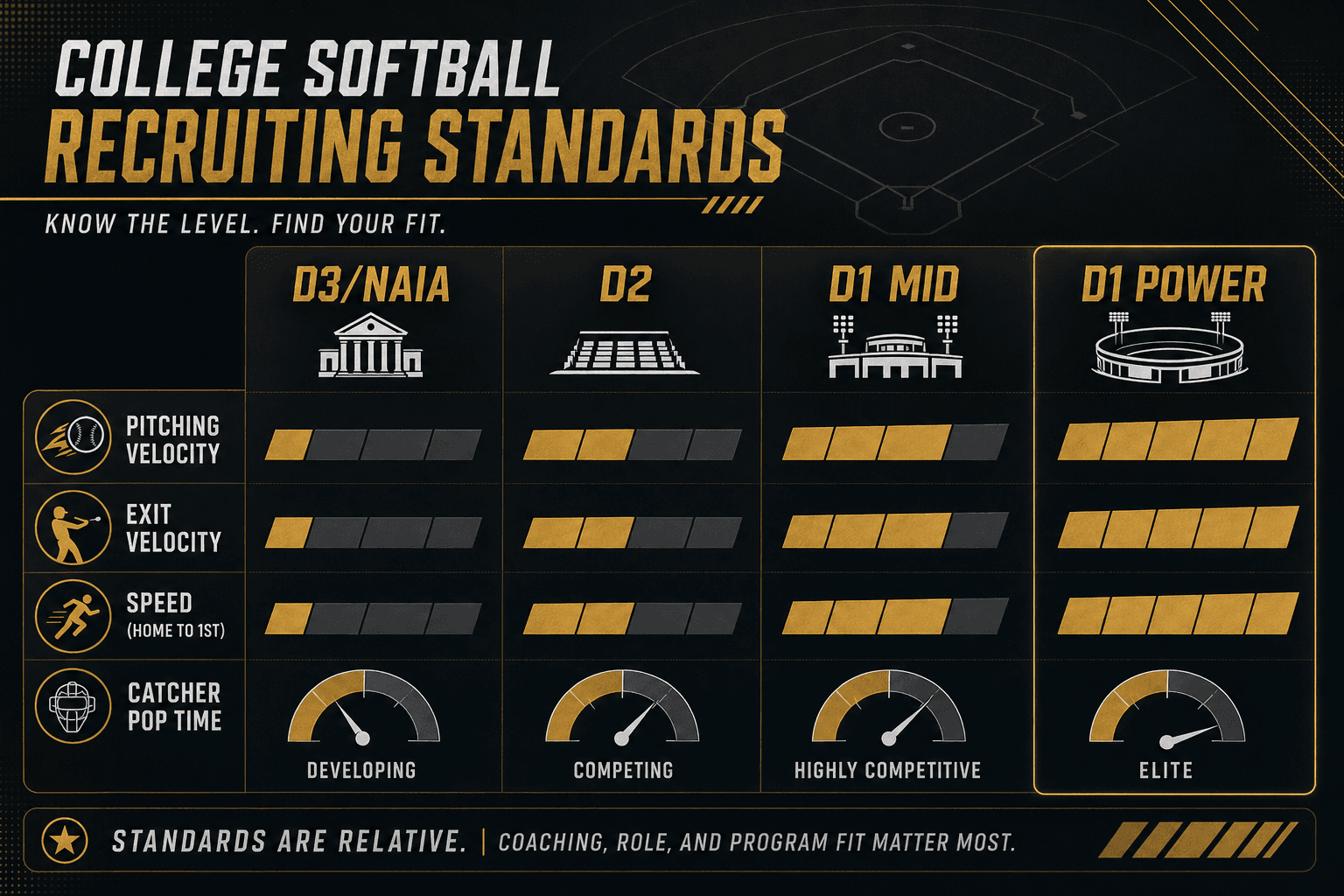
| Metric | D1 Power 4 | D1 Mid-Major | D2 | D3 / NAIA |
|---|---|---|---|---|
| Pitching velocity | 64-70 mph | 60-64 mph | 56-62 mph | 53-58 mph |
| Exit velocity off tee | 72+ mph | 68-72 mph | 64-68 mph | 60-64 mph |
| Home to first | 2.9 sec or faster | 3.0-3.1 sec | 3.1-3.2 sec | 3.2-3.4 sec |
| Catcher pop time | 1.85 or faster | 1.85-1.95 | 1.95-2.05 | 2.05-2.15 |
| Overhand velocity | 70+ mph OF / 65+ IF | 65-70 mph OF / 60-65 IF | 60-65 mph OF / 55-60 IF | 55-60 mph OF / 50-55 IF |
| Academic profile | 3.5+ preferred | 3.2+ preferred | 2.8+ competitive | Admissions-driven |
When should you attend softball showcases and camps?
The best showcase is the one where realistic-fit coaches are actually watching your class and position. Families often spend heavily on national events without checking whether their target schools will attend or whether their team schedule puts them in front of those coaches.
Use sophomore summer and junior summer as your highest-priority showcase windows. Freshman events can help with development and early film, but sophomore and junior events matter most for recruiting evaluation. Senior showcases should be used only when they match schools still recruiting your position.
- Before registering, ask for the attending college coach list and whether those coaches recruit your position and graduation year.
- Choose college camps where your metrics fit the school. A D2 camp where you are an above-average athlete is more useful than a Power 4 camp where you are clearly below the board.
- Send your schedule to coaches 7 to 10 days before the event and follow up within 48 hours after with a short update and film.
- Bring verified numbers. Coaches trust radar, laser timing, and clean video more than parent-estimated metrics.
How should softball coach outreach change at each stage?
Do not wait for a coach to find you. Softball coaches are busy, roster spots are limited, and inboxes are crowded. The athletes who get replies make evaluation easy: clear subject line, verified metrics, film link, schedule, GPA, and a reason the school fits.
NextCommit can write those coach emails for each school on your list, using your profile and the program context so the message does not sound like a mass blast.
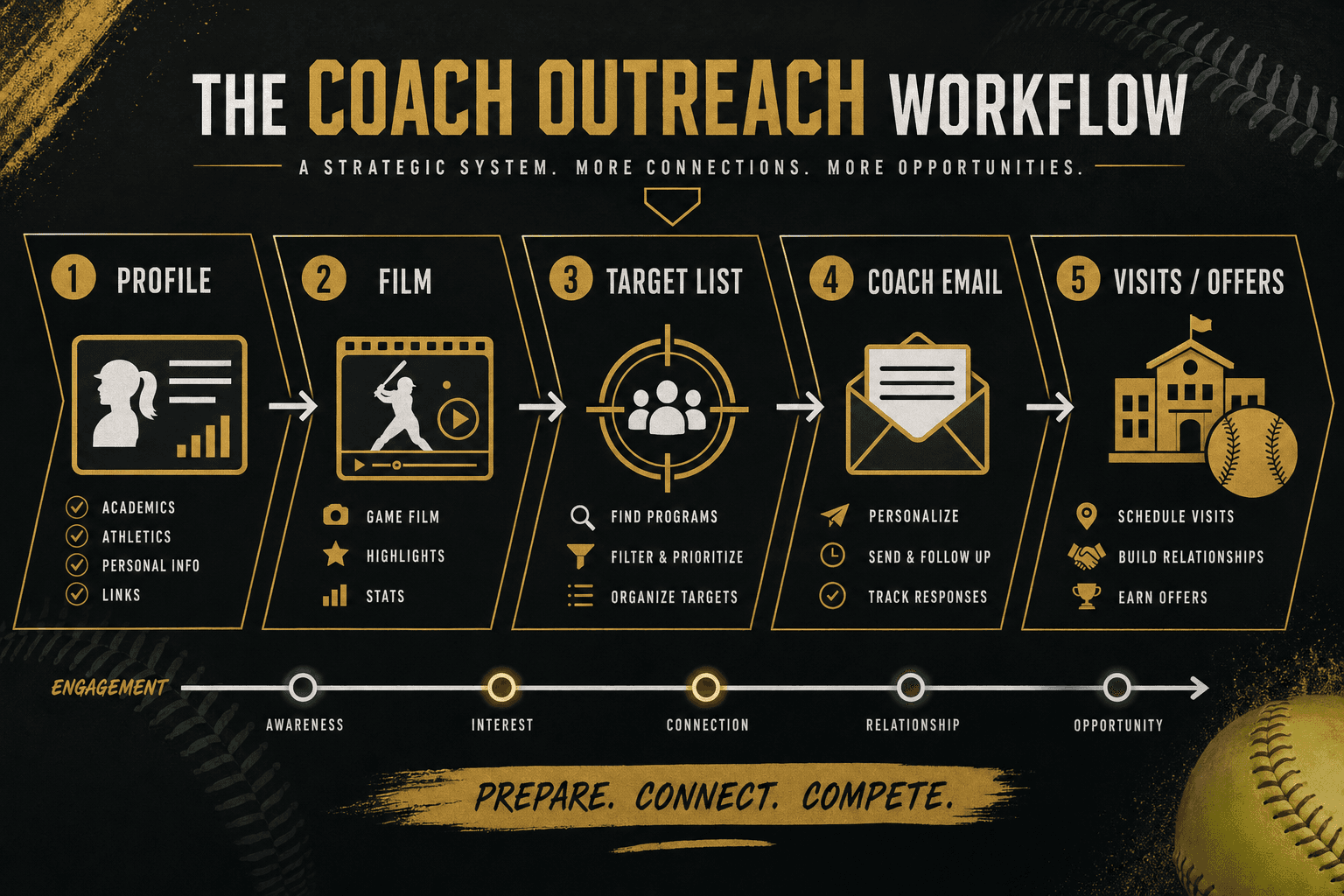
| Stage | Email goal | What to include |
|---|---|---|
| Freshman year | Light introduction only if there is a real reason | Profile link, GPA, position, travel team, strongest measurable, and upcoming schedule. |
| Sophomore year | Get on evaluation lists before September 1 | Skills video, measurable updates, target-fit reason, camp/showcase schedule, and transcript snapshot. |
| Junior year | Convert interest into calls, visits, and offers | Updated film, September 1 availability, position fit, roster questions, and visit interest. |
| Senior year | Find programs still recruiting your position | Senior film, current stats, GPA, test scores, urgency, and direct question about roster availability. |
Get your September 1 email drafted now
The free coach email generator writes a personalized first email that leads with your metrics, film, and schedule.
Turn this timeline into an actual recruiting workflow
A recruiting calendar is only useful if it changes what you do this week. Start by benchmarking your softball measurables, then build a target list around the division levels that fit. From there, send personalized outreach, track which coaches engage, and follow up with useful updates instead of generic nudges.
NextCommit gives softball athletes the workflow behind the calendar: Recruit Score, coach database, AI-personalized emails, email tracking, and follow-up organization. Start with the free Softball Recruit Score, then use the timeline above to decide who to contact and when.
Start your softball recruiting plan free
Benchmark your pitching, hitting, and speed against every division, then send 10 personalized coach emails a week at no cost.
Written by
Preston Viltz
Co-founder and Head of Growth, NextCommit
Preston Viltz is a co-founder and Head of Growth at NextCommit. He played college baseball at Sacramento State, Lower Columbia College, and the University of Washington after graduating from Kentridge High School in 2018, and he ran his own recruiting outreach as a lightly recruited player, which is the process NextCommit was built to fix.
- Co-founder and Head of Growth, NextCommit
- College baseball: Sacramento State, Lower Columbia College, University of Washington
- Kentridge High School, Class of 2018
More guides by Preston and the editorial policy.
Sources
Where these numbers come from
- National Fastpitch Coaches Association Softball recruiting resources and calendar.
- NCAA recruiting calendars Official contact, evaluation, quiet, and dead periods by sport and division.
- NCAA 2026-27 Division II Manual (Legislative Services Database) Bylaws 13.02.2 and 13.1.3.1: recruiting materials, calls, texts, and emails at any time since August 1, 2024 (Proposal NC-2025-14); Bylaw 13.1.1.1: no in-person contact before June 15 before junior year; Bylaw 13.3.1.2: official visits from the same date, checked October 8, 2026.
- NCAA Eligibility Center Registration, core-course, and amateurism requirements for Division I and II.
- NCAA athletics aid agreements and signing dates Signing periods and what replaced the NLI.
- NextCommit study: what gets college coaches to reply (2026 data) Open rates, list size, follow-ups, reply timing, and best send windows by sport.
FAQ
Questions athletes and parents ask
When should softball recruiting start?
Softball recruiting should start freshman year with profile building, film, academics, and measurable tracking. Sophomore year is when athletes should build a school list, attend targeted camps and showcases, and begin athlete-initiated outreach. Junior year is the peak D1 communication window because September 1 of junior year is when D1 softball coaches can begin direct recruiting communication under current NCAA rules.
What is the most important D1 softball recruiting date?
September 1 of junior year is the key D1 softball recruiting date. That is when D1 coaches can begin direct recruiting communication, including calls, texts, emails, and recruiting conversations tied to visits. Athletes can email coaches before then, but D1 coaches are restricted in how they can respond.
What should softball players do before September 1 of junior year?
Before September 1 of junior year, softball players should have a recruiting profile, skills video, current GPA, verified measurables, travel schedule, and a realistic target list of 30 to 50 programs. The strongest athletes also send introductory emails before that date so coaches can evaluate them even if they cannot yet reply with full recruiting communication.
What softball measurables should recruits track?
Softball recruits should track pitching velocity, spin and movement, exit velocity, home-to-first time, 60-yard dash, catcher pop time, overhand throwing velocity, GPA, test scores, and game film. The exact priority depends on position, but every athlete needs enough verified data for coaches to quickly understand division fit.
How does the D1 25-player roster cap affect the timeline?
The D1 25-player roster cap means every roster spot is more intentional. Coaches can fund more players at opted-in programs, but they also have fewer extra roster spots for developmental athletes. That makes early measurable tracking, realistic targeting, and consistent outreach more important because coaches have less room to take speculative players late.
Is senior year too late for softball recruiting?
Senior year is late for most Power 4 D1 opportunities, but it is not too late for D2, D3, NAIA, and JUCO programs. Seniors should lead outreach with updated film, senior stats, current measurables, GPA, and a travel or high school schedule. They should expand the list quickly and prioritize programs where their numbers clearly fit.